The industry is treating GEO as if it is just SEO with a different algorithm. It is not just that.
Welcome to the GEO and Agentic Commerce Series
In this series, I look at four connected questions: how AI changes visibility, what agents actually see on websites, the infrastructure behind the machine web, and why payments may become the most strategic layer of all.
This article is part 1 of this series.
What Started This For Me
Over the past few weeks, I’ve been spending a lot of time looking at how products show up, or fail to show up, inside AI answers.
One pattern kept bothering me because it was not what I expected to see. Some very strong brands, brands with real awareness, real budgets, and competitive products, were still underperforming in AI recommendation environments.
Why GEO Is Not Just About Getting Scraped
The terminology is still settling, so it is worth being explicit.
The term GEO, or Generative Engine Optimization, was formalized in a 2023 paper by Aggarwal et al., and it is also the term used by organizations such as a16z. Gartner tends to use AEO, for Answer Engine Optimization. You will also see other labels such as GSO and AIO.
As a CMU alum, I have a soft spot for grounding this in the academic framing, so I am going to use GEO in this series. But the label matters less than the underlying shift it is trying to describe.
Generative Engine Optimization, or any of the terms above, is usually used to describe optimization tactics to help brands get discovered by AI.
That is not wrong, exactly. But it undersells what is actually changing.
SEO was built for a world where traffic was the key moment. A person searched, saw a list of links, clicked through, and then started evaluating options. You could track impressions, clicks, rankings, bounce rate, and conversions. Even if you were not in the top slot, you were still visible enough to compete.
What GEO is grappling with is different. It is not just a new ranking surface. It changes where the decision begins to form.
Why This Is Already Urgent
McKinsey’s research points out that among surveyed European consumers using AI for shopping, 63 percent use it to compare brands, models, and prices, and 38 percent use it to research products or decide what to purchase.
That is a very different problem from traffic loss in the SEO era. You are not losing traffic first. You are losing the moment when users are comparing and making decisions.
The recommendation, the comparison, and often the narrowing of options now happen before the click. Sometimes the click never comes at all. By the time the person reaches a brand site, a surprising amount of the evaluative work may already be over.
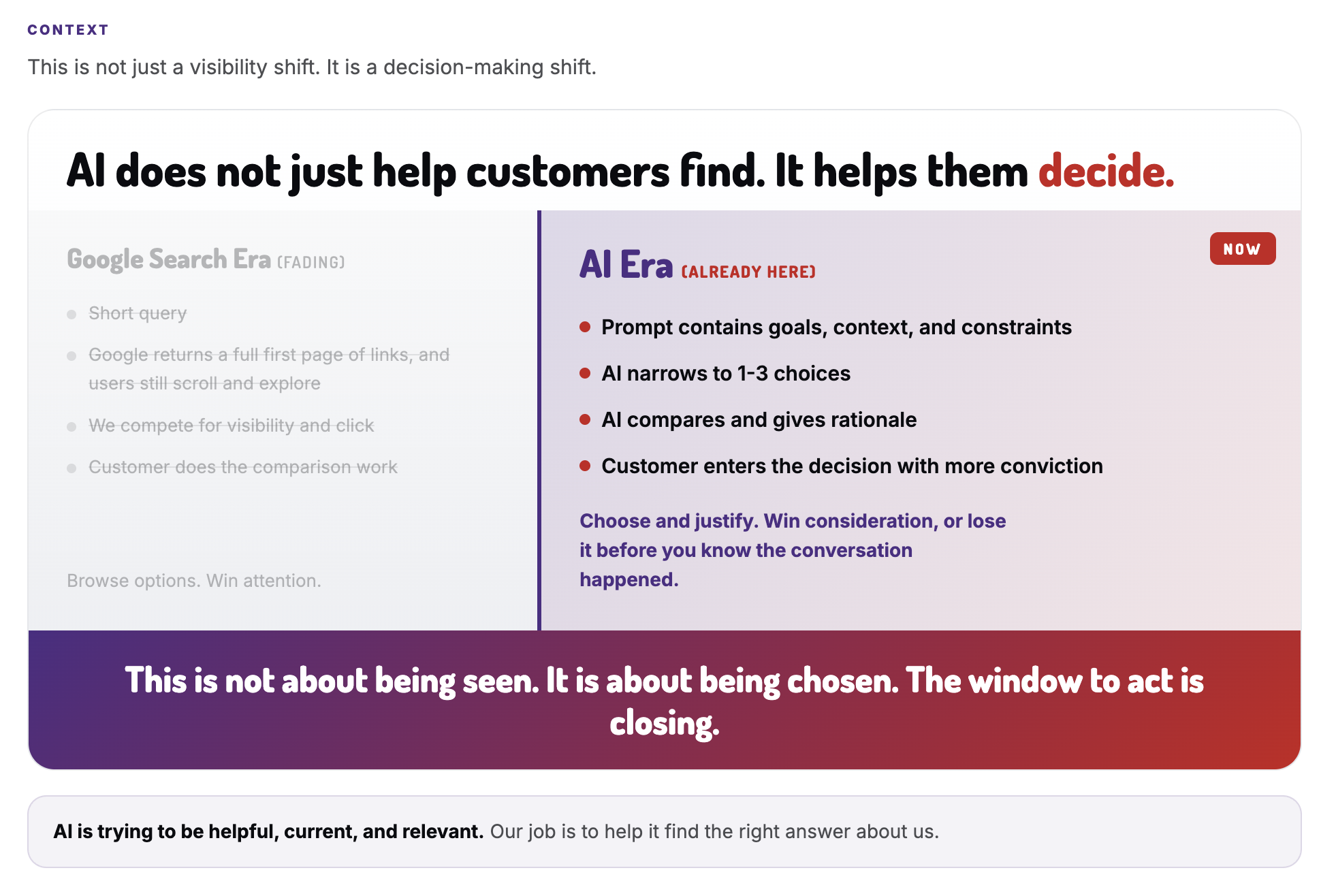
Key differences, Search Era vs. AI Era
In the Search era, people searched, opened several links, and did the comparison work themselves.
In the AI era, that comparison increasingly happens inside the interface. AI takes the prompt, narrows the options, explains the trade-offs, and shapes the shortlist before the click ever happens. That means the challenge is not only getting seen. It is making sure you are the option AI is confident enough to choose.
What Current Tools Still Miss
This is also why I think a lot of current AI visibility tooling is still answering the easiest question rather than the most useful one.
The easy question is: did your brand appear in the answer?
That matters, of course. But it is not enough. A mention is not the same as a recommendation, and a recommendation is not the same as a confident, accurate, complete comparison.
Three Questions I Would Actually Want Answered
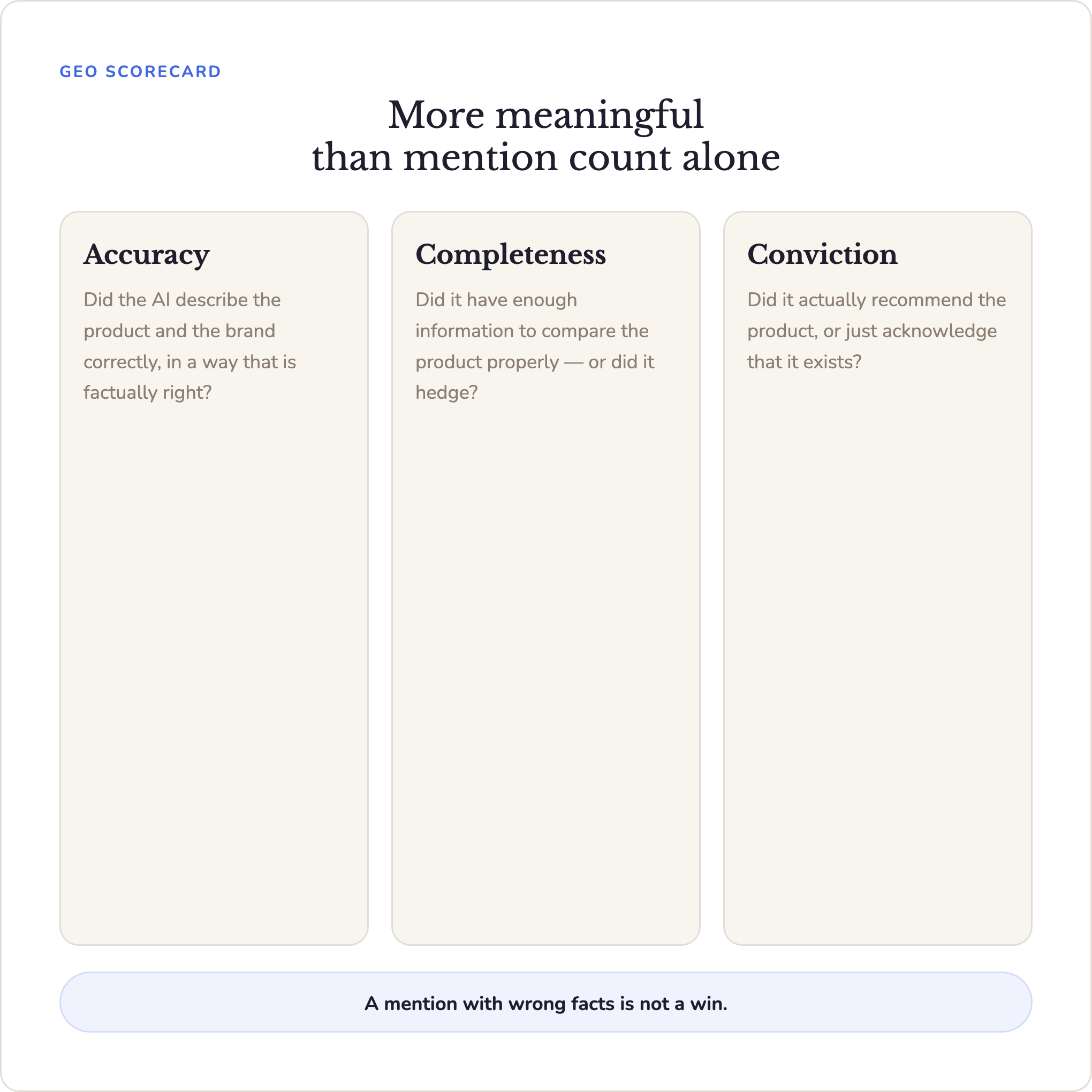
- Accuracy: Did the AI describe the product and the brand correctly, in a way that is factually right and directionally aligned with how the brand should be understood?
- Completeness: Did it have enough information to compare the product properly?
- Conviction: Did it actually recommend the product, or just acknowledge that it exists?
A mention with wrong facts is not a win. A hedged mention is also not the same as being shortlisted with a clear rationale.
That gap matters because it is the gap between being visible and being influential. I also think it matters because accuracy and completeness are things you, as a brand owner or internal team, often understand better than a third-party tool or external dataset ever will.
So if I were scoring GEO seriously, I would not stop at mention count.
Why Product Legibility Matters More Than Ever
In a separate McKinsey article on AI-powered search, the firm notes that a brand’s own sites may make up only about 5 to 10 percent of the sources AI search references. That already means many teams are optimizing only a thin slice of what shapes the answer.
In my own smaller tests, I did not land on the exact same percentage split McKinsey reported. But I kept seeing the same broad pattern. Brand sites do matter, sometimes a lot, especially when they expose clean comparison data. At the same time, they are often not enough on their own.
When users ask for “best value,” ask an AI to compare options, or ask it to filter out products that do not fit specific criteria, the system needs something very concrete to work with.
In financial products, for example, it often tries to extract things like fees, rates, eligibility rules, reward mechanics, and clear advantage tables. If that information is easy to access and easy to normalize, the brand page has a real chance to be part of the answer.
But if that same information is scattered across tabs, buried in PDFs, wrapped in inconsistent labels, or mixed too heavily with marketing copy, the model often shifts toward sources that have already done the normalization work.
Why Comparison Sites Keep Showing Up
That is one reason comparison sites show up so often. They tend to present products in rows and attributes. They are already built around filters, exclusions, and side-by-side tradeoffs. In other words, they often look closer to the machine’s job than the brand page does.
So I would not reduce this to “third-party good, brand site bad.” The more useful takeaway is that brand sites increasingly need to become better source material for comparison itself.
This is why I do not think the real issue is brand weakness.
It is product legibility.
A company can be strong in human perception and weak in machine comparison at the same time. That is the part many people still have not fully internalized.
The question is not only who published the content. It is which source made the product easiest to compare.
Who Should Drive It
And that brings me to the organizational question I keep returning to.
Who should drive GEO inside most companies?
- Marketing owns the brand.
- SEO owns search visibility.
- Product owns product information.
- Legal owns terms and disclosures.
- Engineering owns rendering, data systems, and APIs.
The actual capability that determines whether an AI system can represent your product correctly sits across all of them.
That is one reason this shift gets misframed so easily. Everyone sees one slice of the problem through the tools they already have. The SEO team sees rankings. The content team sees messaging. The product team sees specifications. The engineering team sees rendering and structure.
My instinct is that marketing still needs to play a leading role here, because the end goal is still representation, positioning, and choice. But it cannot be a solo role. It has to be a more technical, more cross-functional kind of marketing leadership.
So the problem is not simply that nobody owns it. The problem is that very few teams currently know how to own it together in a structured way.
What This Means Now
So when people ask me whether GEO is just SEO renamed, my answer is no.
And when people ask what GEO actually covers, my answer is: decisions, not just discovery. The most important moment may now be one that happens before anyone types a URL.
The bigger question is whether your products are legible enough to participate in AI-mediated comparison and recommendation at all.
Some companies are already learning that brand strength does not guarantee machine legibility. Some are discovering that one product line can be highly visible while another becomes nearly invisible inside the same company because the underlying information architecture evolved differently over time.
That should make all of us a little less comfortable, because it means the gap is not only between brands. It is also inside brands.
The brand age is not ending neatly. It is splitting into products and companies that have been translated into machine-readable, machine-comparable form, and those that have not.
The question is no longer only whether people can find you. It is whether AI systems can understand you well enough to place you in the shortlist before a human ever arrives.